How to Get Rid of Spiders for Good

Spiders love a clean house. That seems wrong, right? You think a spotless home is safe. But it's not about the dirt.
It’s a frustrating feeling. Spiders don't care how tidy your space is. They are looking for shelter. They are looking for food. Your clean home is a perfect hunting ground for them. If this sounds like your house, you can get help right away by calling +1 855 224 3071.
Your Home Is Not Actually Spider-Proof
Most people think a spotless house is a spider-free house. That’s a myth I hear all the time. The reality is, spiders aren't drawn to dirt and grime like ants or roaches are; they’re looking for two things: shelter and food (other bugs). Your clean, climate-controlled home is basically a perfect hunting ground for them.
The numbers might shock you. A 2016 survey of homes in North Carolina found that a staggering 100 percent of homes contained spiders. The average home had around 62 spiders, with these eight-legged tenants found in 68% of bathrooms and 77% of bedrooms.
Seeing a spider isn’t a sign that your home is dirty. It’s just a sign that your home is a home. If you want to dig into the data, you can explore the full study about household spiders.
Understanding Why Spiders Are Inside
Spiders come inside for simple, practical reasons. They’re either ducking out of bad weather, searching for a mate, or—most commonly—following their food source. If you have a few flies, ants, or gnats buzzing around, you’ve basically put out a welcome mat for spiders.
Think of it this way: spiders are your home’s unpaid pest controllers. But let's be honest, most of us would rather not have them on the payroll. The real key to getting rid of spiders is making your home less attractive to them and the insects they eat. If the problem feels out of control, you can get immediate help by calling +1 855 224 3071.
The First Steps to Reclaim Your Space
Before you reach for a harsh chemical spray, let's start with some immediate, practical actions. These simple moves disrupt a spider’s habitat and cut off their food supply, making a real difference right away.
When you find a spider problem, it's easy to feel overwhelmed. This simple action plan breaks down what you can do right now, from easy DIY fixes to knowing when to call in the pros.
Immediate Spider Control Action Plan
| Action Item | Effort Level | Best For | Professional Alternative |
|---|---|---|---|
| Declutter Key Areas | Low | Reducing hiding spots in basements, attics, and garages where spiders love to hang out. | A pro can identify and treat "hot spots" you might miss. |
| Regular Web Removal | Low | Immediately removing spiders, webs, and egg sacs to break the breeding cycle. | Technicians use specialized tools for high corners and hard-to-reach areas. |
| Seal Entry Points | Medium | A long-term fix for keeping new spiders out by sealing cracks and gaps. | Professional exclusion services offer a more thorough and durable seal. |
| Control Other Pests | Medium | Cutting off the spider's food supply by dealing with flies, ants, or other insects. | A comprehensive pest control plan that targets all pests, not just spiders. |
Taking these initial steps is about shifting from reacting to every spider you see to proactively managing your home's environment. It's the foundation for a real, long-term solution.
By decluttering, vacuuming webs, and sealing gaps, you’re not just killing spiders—you’re making your home a place they want to avoid. This proactive approach is always more effective than just spraying chemicals.
Of course, if the problem feels too big or you're dealing with a potentially venomous species, don't hesitate. Calling a professional at +1 855 224 3071 can give you immediate relief and a solid plan to keep them out for good.
Identifying Your Uninvited Spider Guests
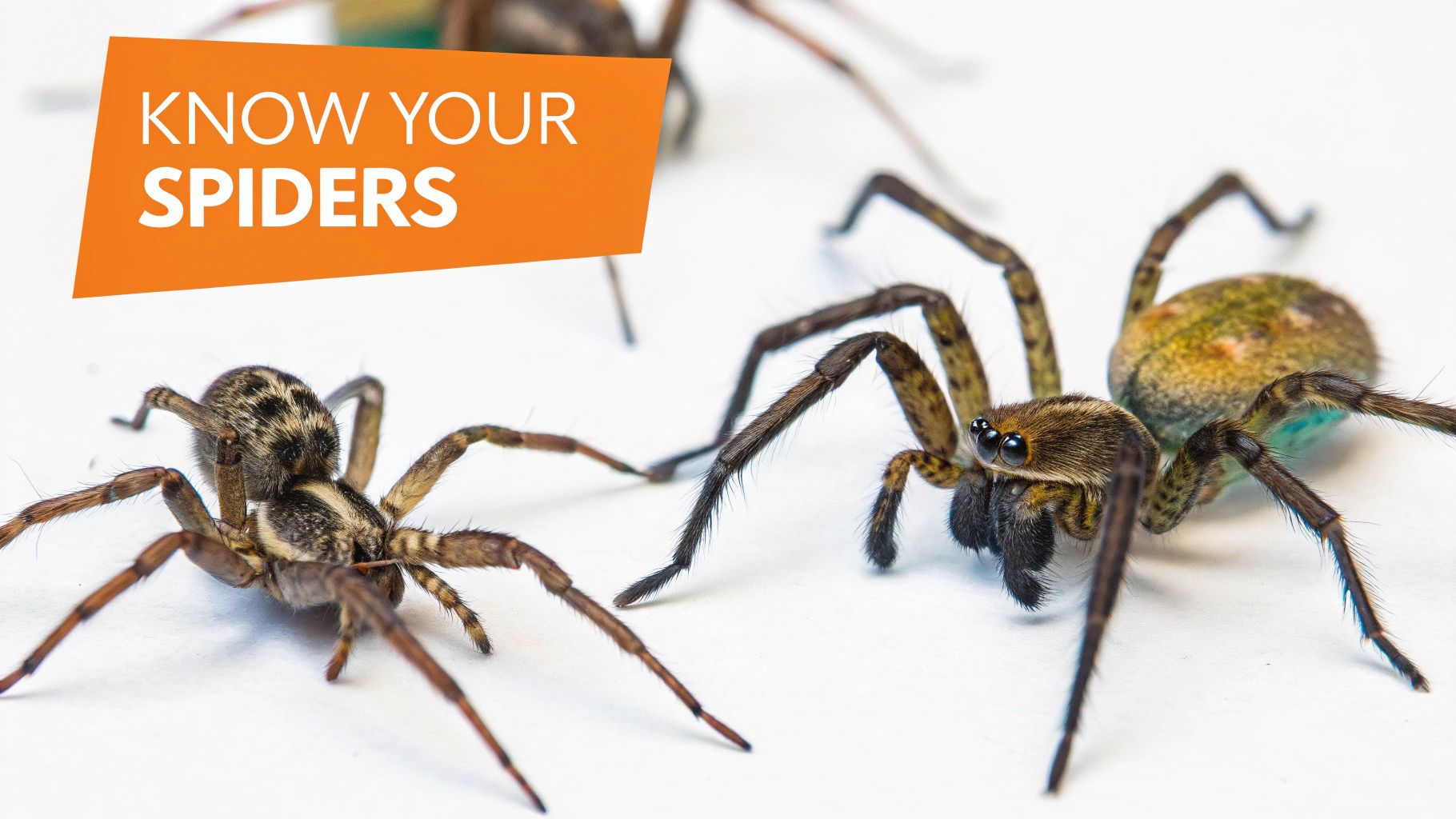
You might think a spider is just a spider, but that’s a rookie mistake. Some are harmless roommates, while others are a genuine problem. Knowing which is which is the single most important first step to getting rid of them for good.
Spotting a tiny house spider is a completely different ballgame than finding a black widow in the garage. One calls for a cup and a piece of paper; the other requires immediate, cautious action.
This is where a little know-how makes all the difference. Correctly identifying the spider in your home helps you gauge the real risk and choose the right battle plan.
Common Household Spiders
Let's be clear: most spiders you find indoors are not dangerous. They're usually just lost, looking for shelter, or hunting the other pests that have already snuck inside your home.
Here are a few of the usual suspects you'll run into:
- American House Spider: Small, brownish, and famous for its messy, tangled webs in corners and windows. They're totally harmless and even act as free pest control, catching flies and other annoying insects.
- Cellar Spider (Daddy Long-Legs): You know these guys. They have tiny bodies and incredibly long, thin legs. They build those wispy, delicate webs in quiet spots like basements, garages, and cellars.
- Wolf Spider: These are the hunters, not web-builders. They're bigger, usually brown or gray, and move with alarming speed. While they look intimidating, their bite isn't medically significant to people.
These common spiders are more of a nuisance than a real threat. But if you're seeing a lot of them, it could be a red flag that you have a bigger pest issue they're feeding on. If that's the case, a quick call to +1 855 224 3071 can get you a professional opinion.
The fear of spiders is incredibly common, but the actual danger is often blown way out of proportion. While spiders can seem menacing, a comprehensive review of medical cases found that in 78% of supposed spider bites, there wasn't enough evidence to even confirm a spider was involved. Learn more about the real risks of spider encounters.
Medically Significant Spiders to Watch For
While most spiders are harmless, a couple of species found in the United States absolutely require your respect and caution. Misidentifying one can give you a false sense of security, so learning their key features is non-negotiable for your safety.
If you even suspect you have one of these in your home, do not try to handle it yourself. Your safety comes first. Call +1 855 224 3071 for immediate, expert identification and removal.
Let's break down the two you really need to worry about:
Black Widow Spider
- Appearance: Unmistakable. They have a shiny, black body and the iconic red hourglass marking on the underside of their abdomen.
- Web: They build irregular, tangled, and sticky webs, often close to the ground in dark, protected spots like woodpiles, sheds, or cluttered basements.
- Risk: Their venom is a powerful neurotoxin. A bite is a medical emergency and requires immediate attention.
Brown Recluse Spider
- Appearance: Tan to dark brown with a distinct, violin-shaped marking on its back. The "neck" of the violin always points toward the spider's rear.
- Habitat: True to their name, they are reclusive. They hide in dark, dry, undisturbed places—think behind furniture, deep in closets, or inside storage boxes.
- Risk: Their venom is cytotoxic, meaning it can destroy tissue. A bite can cause a necrotic lesion (an ugly open sore) that heals very slowly and can get infected.
Knowing the difference between a harmless cellar spider and a dangerous brown recluse is the most important skill you can have. It empowers you to act the right way—whether that means reaching for a dustpan or the phone.
If there's ever any doubt, assume it's dangerous and call a professional at +1 855 224 3071. It's just not worth the risk.
Your Practical DIY Spider Removal Toolkit
Think you need a hazmat suit to get rid of spiders? Not at all. A lot of people believe harsh chemicals are the only answer for any pest problem, but the truth is, your kitchen pantry probably holds everything you need to get started.
Effective spider control often begins with simple, accessible tools. Before you run out and spend a dime, let's put together a DIY toolkit with items you likely already have. These methods aren't just effective; they're also much safer for your family and pets.
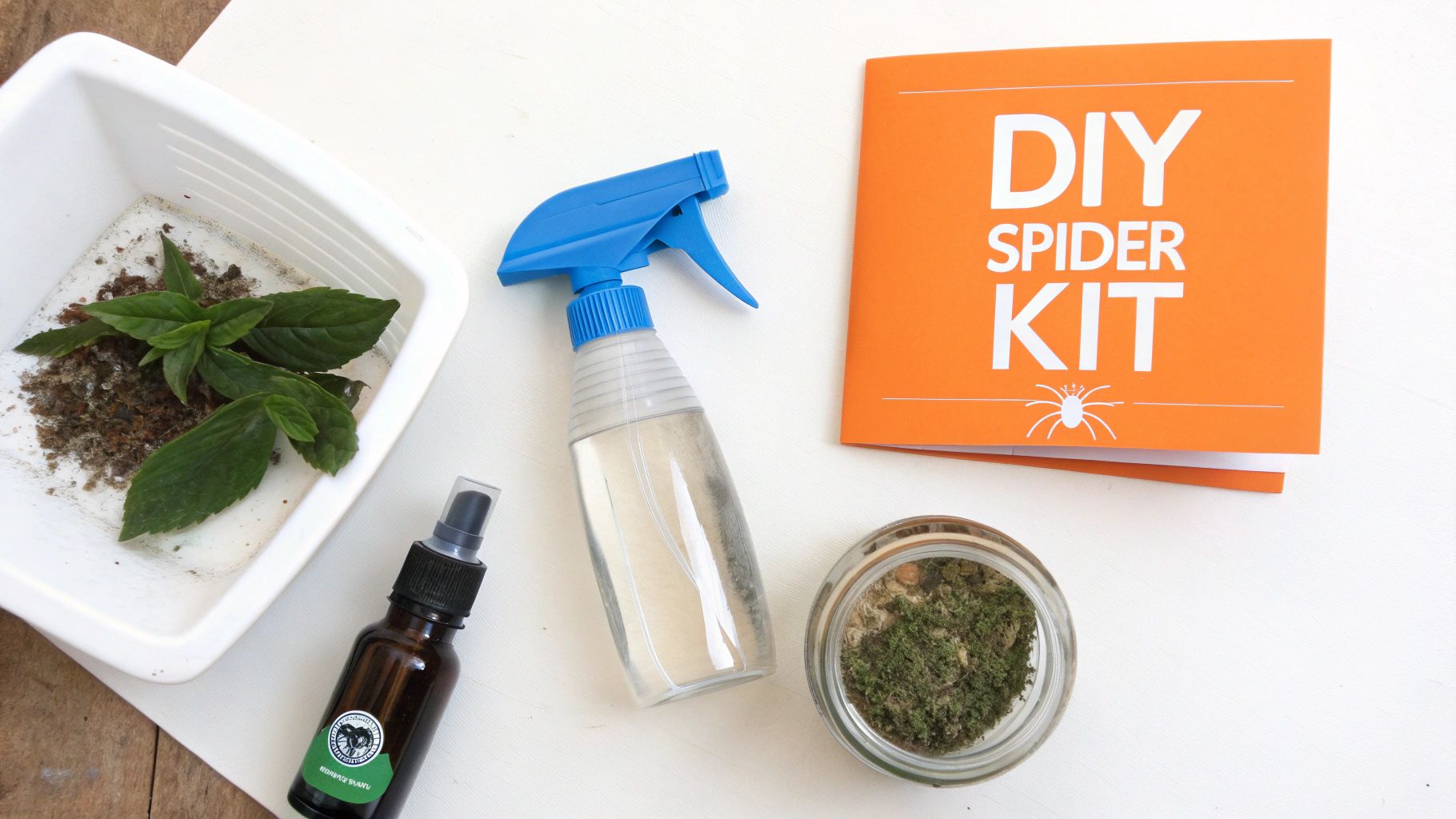
Go-To Natural Spider Repellents
Spiders have a surprisingly sensitive sense of smell, and you can absolutely use that against them. Strong scents that we find pleasant can be completely overwhelming for spiders, making natural repellents an excellent first line of defense.
One of the most popular and reliable natural options is peppermint oil. Spiders can't stand its strong, minty aroma.
- How to Use It: Just mix 15-20 drops of pure peppermint essential oil with water in a spray bottle. Shake it up and spray liberally around window frames, doorways, baseboards, and any dark corners where you’ve seen them hiding.
- The Good: It's non-toxic, makes your house smell great, and is totally safe around kids and pets.
- The Catch: The scent fades, so you'll need to reapply it every few days to keep that invisible barrier strong.
Another powerful staple you’ve already got is white vinegar. The acetic acid that makes it a great cleaner is also a potent spider deterrent. Mix a 50/50 solution of white vinegar and water in a spray bottle. Be careful on delicate surfaces since the acid can cause damage, but it's perfect for spraying foundations, window sills, and garage interiors.
Expert Tip: Don't just spray and walk away. For these natural repellents to actually work, consistency is everything. Make it part of your weekly cleaning routine to refresh the spray in key areas. This creates a lasting barrier that tells spiders your home is off-limits.
Strategic Traps and Physical Barriers
Sometimes, you need to do more than just repel spiders—you need to catch them or create physical barriers they can't cross. This is where sticky traps and diatomaceous earth come in handy.
Sticky traps are simple, non-toxic glue boards that catch spiders and other crawling pests. They won't solve a huge infestation on their own, but they are incredibly useful for two things: figuring out where the spiders are coming from and reducing their numbers in specific spots.
- Where to Place Them: Lay them flat in low-traffic, high-spider zones. Think along the walls in your basement, in the back of closets, under furniture, and in the garage.
- What They Tell You: A trap that's full in a few days is a huge red flag. It tells you exactly where your spider hot spot is so you can focus your efforts there.
Diatomaceous Earth (DE) is another fantastic tool. This fine, white powder is made from fossilized aquatic organisms. To us, it feels soft, but to a spider with an exoskeleton, it's like crawling over microscopic shards of glass.
Make sure you're using food-grade DE, which is safe for homes with pets and children. Lightly dust it in areas where you've seen activity—behind appliances, under sinks, and along the perimeter of your basement. It creates a long-lasting physical barrier that works as long as it stays dry. If you're still seeing spiders after trying this, a professional assessment is your next best move. Call us at +1 855 224 3071 to connect with an expert right away.
Creating Your Action Plan
Having the right tools is one thing, but using them effectively is what gets results. You can—and should—combine these DIY methods for a much more powerful approach to spider control.
Here’s a practical plan to get you started:
- Initial Cleanup: First, do a thorough vacuuming of the area. Make sure you suck up any visible spiders, webs, and especially egg sacs. This removes the immediate problem.
- Apply Repellents: After cleaning, spray your peppermint oil or vinegar solution around all potential entry points and hiding spots.
- Set Up Barriers: Lay down a light dusting of diatomaceous earth along baseboards and in cracks. Place sticky traps in secluded corners to monitor for any stragglers.
This multi-layered strategy tackles the problem from several angles, making it much harder for spiders to stick around. For more ideas on managing household pests yourself, our guide on do-it-yourself home insect control offers even more strategies.
However, if you find that DIY methods aren't cutting it or the infestation is bigger than you realized, don't hesitate. Professional help is available 24/7 when you call +1 855 224 3071.
Creating a Spider-Proof Barrier Around Your Home
Squashing a spider might feel like a victory, but it's a short-lived one. The real way to win the war against spiders isn't about chasing them down one by one—it’s about making sure they can't get inside in the first place.
Long-term control is all about prevention. This means shifting your focus from reacting to every web you see to proactively turning your home into a fortress spiders can't breach. It's about sealing up their secret entrances and making your entire property less appealing to them.
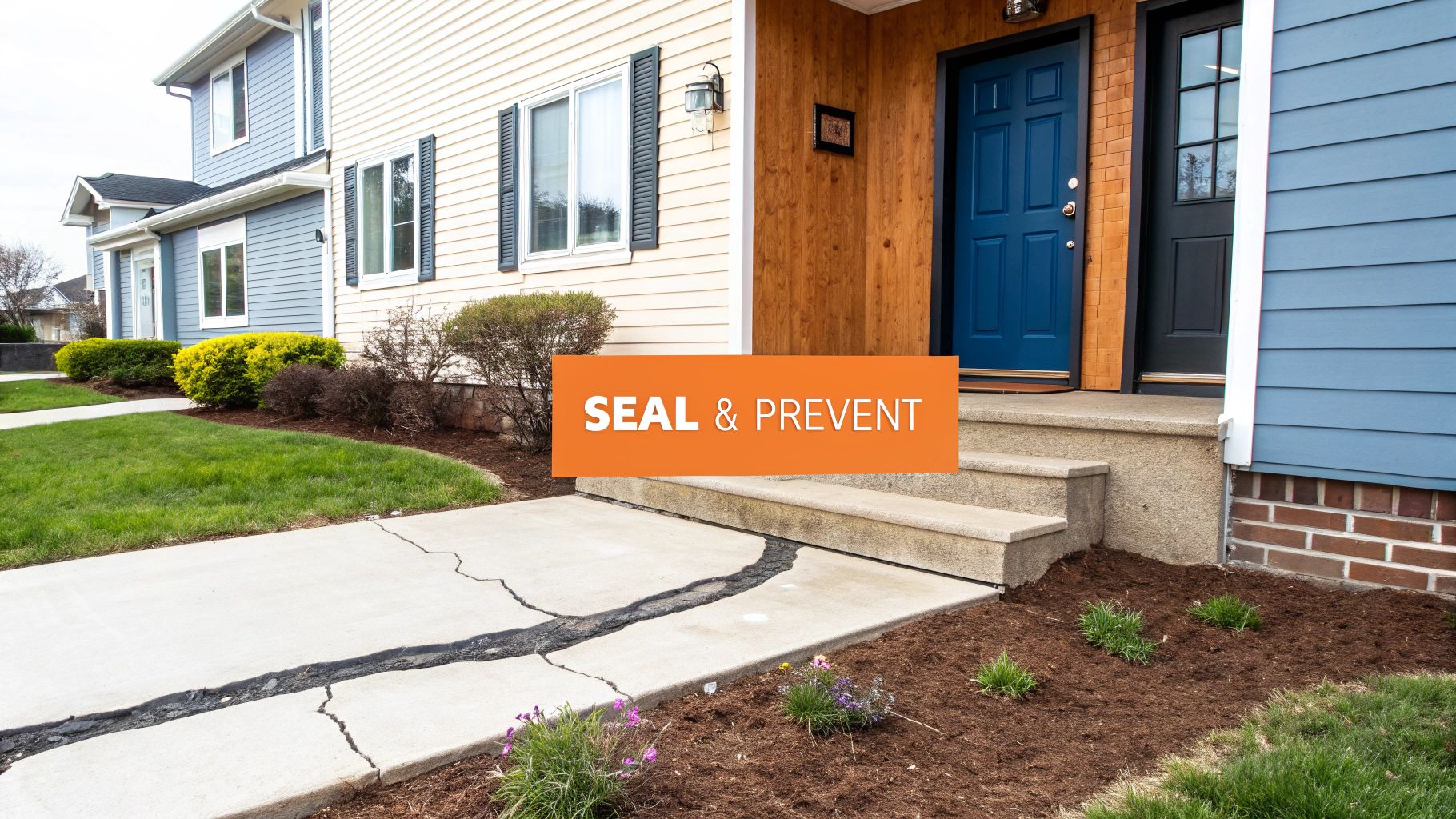
This proactive strategy is the core of any effective pest management plan. You build a strong defense to stop infestations before they even begin. If creating this kind of barrier feels overwhelming, our team is always ready to help. Just give us a call at +1 855 224 3071 for a full evaluation.
Sealing Every Crack and Crevice
Spiders don't need much room. A crack that looks tiny to you is a wide-open doorway for an eight-legged intruder. Your first job is to walk the perimeter of your home and look at it through the eyes of a pest trying to get in.
Start with the foundation. Look for any gaps in the mortar, cracks in the concrete, or spots where siding has pulled away. A good quality silicone caulk is your best friend here. Pay extra close attention to where utility lines, pipes, and faucets enter the house—these are notorious weak spots for pests.
Next up are your windows and doors. Check the weather stripping and door sweeps for wear and tear. If you can see daylight peeking through, that’s more than enough space for a spider. Replacing worn-out seals is a cheap fix that makes a huge difference. Torn or damaged window screens are another welcome mat for pests, but learning how to repair a window screen is a simple DIY project that pays off big time.
Pro Tip: Sealing your home isn't a one-and-done job. Your house settles and weather takes its toll, creating new openings over time. Get in the habit of doing a full exterior inspection every spring and fall to catch and seal new vulnerabilities.
Making Your Yard Less Spider-Friendly
Your yard can either be a buffer zone or a breeding ground for spiders. Right now, you get to choose. Spiders love clutter and overgrown vegetation because it gives them shelter and attracts the insects they hunt.
Start by clearing the area immediately around your foundation.
- Move woodpiles and compost bins at least 20 feet away from the house. These are five-star hotels for spiders, especially black widows.
- Trim shrubs, trees, and ivy so nothing is touching your siding or roof. Branches are basically a highway for pests to walk right onto your house, bypassing any ground-level defenses.
- Rake up leaves, grass clippings, and other debris regularly. Piles of organic junk create the perfect damp, dark environment that spiders and their prey love.
Outdoor lighting is another huge factor. Standard white or blue-tinted bulbs are like a neon "all-you-can-eat buffet" sign for bugs. They attract moths, flies, and beetles, which in turn attract spiders looking for dinner. Switch your outdoor bulbs to yellow "bug lights" or sodium vapor lights. They are far less attractive to most flying insects, effectively shutting down the nightly buffet.
If you've done all this and still have a spider problem, don't hesitate to call +1 855 224 3071 for professional help.
Disrupting the Spider Life Cycle Indoors
Even with a sealed-up exterior, you need to make the inside of your home an unpleasant place for spiders to live. That means taking away their hiding spots, their food, and their ability to reproduce.
Deep, regular cleaning is your best weapon. Don't just vacuum the middle of the floor—use your vacuum’s attachments to get into corners, behind furniture, along baseboards, and inside closets. This sucks up not only adult spiders and their webs but, more importantly, their egg sacs. A single egg sac can hold hundreds of spiderlings, so removing them is critical.
Rethink your storage, too, especially in places like basements, attics, and garages.
- Ditch cardboard boxes for airtight plastic bins. Spiders love the dark nooks and seams of cardboard.
- Get everything off the floor. Use shelving to elevate your belongings. This eliminates countless hiding spots and makes it much easier to keep the area clean.
This multi-layered approach—combining exclusion, yard cleanup, and indoor sanitation—is a core principle of what experts call Integrated Pest Management (IPM). You can learn more about this smart strategy by reading our guide on https://pestcontrol-service-finder.com/blog/what-is-integrated-pest-management/. It’s far more effective than any single method alone. If you need a hand putting a full prevention plan in place, our experts are just a call away at +1 855 224 3071.
Knowing When to Call a Professional Exterminator
Most people see calling a pro as admitting defeat—the expensive, last-ditch effort. But the truth is, waiting too long is often the most expensive mistake you can make.
Handling a random spider here and there is one thing. But if you’re stuck in an ongoing battle that never ends, your DIY efforts might be costing you more in time, stress, and store-bought sprays than a single professional visit would. Knowing when you've hit that tipping point is the key.
Red Flags Your Spider Problem Is Out of Control
So, you’ve been diligent. You've sprayed, cleaned, and sealed every crack you can find, yet the spiders keep showing up. This is the #1 sign that the infestation has deeper roots than you can reach.
Recurring infestations almost always point to a hidden entry point you missed or a much larger population than you first thought. If you’re constantly finding spiders or new webs just days after a deep clean, it’s time to admit the source of the problem is beyond a simple surface spray.
The other huge red flag? Finding spider egg sacs. One of those little silk balls can hold hundreds of baby spiders. Finding several in your basement, attic, or garage means you aren’t just dealing with a few adults—you're dealing with a full-blown nursery waiting to hatch.
When you move from spotting individual spiders to finding evidence of breeding, the game has changed. At this point, you're no longer just removing spiders; you're fighting an established population that can quickly multiply.
If you’re seeing these signs, it's a clear signal to stop the solo fight. A professional can figure out what's really going on in minutes. For an immediate evaluation, give us a call at +1 855 224 3071.
The Professional Advantage
So what does a pro bring to the table that you can't get from a bottle at the hardware store? It really boils down to three things: expertise, equipment, and efficiency.
Professionals are trained to think like pests. They don’t just spray where you see a web; they conduct a full-blown investigation to find out why the spiders are there in the first place. That's the real difference between just killing a bug and solving the problem for good.
This is a key distinction between a basic exterminator and a pest control technician. If you want to dive deeper into the different approaches, our article on exterminator vs. pest control services breaks it all down.
Here’s what you get with a professional service:
- Expert Identification: A pro can instantly tell a harmless house spider from a dangerous Black Widow or Brown Recluse, making sure the right (and safe) treatment is used.
- Commercial-Grade Treatments: The products available to licensed technicians are far more potent and last much longer than anything you can buy over the counter.
- Root Cause Analysis: They’ll find and help you fix the underlying issues, like a moisture problem in the crawl space or another pest infestation (like ants or flies) that’s serving as a spider buffet.
DIY vs Professional Spider Control
Trying to figure out if you can handle it or if it's time to call for backup? This table breaks down the key differences to help you decide.
| Factor | DIY Approach | Professional Service | When to Choose |
|---|---|---|---|
| Scope of Problem | A few individual spiders, small, visible webs. | Recurring infestations, multiple egg sacs, venomous spiders. | Choose a pro when the problem feels like it’s multiplying, not shrinking. |
| Effectiveness | Short-term, surface-level. Kills spiders on contact. | Long-term solution. Addresses the root cause and breeding cycle. | Choose a pro for a solution that lasts, not just a quick fix. |
| Safety | Risk of misusing chemicals or misidentifying spiders. | Trained & licensed to handle potent products safely. | Choose a pro if you have kids or pets, or suspect venomous spiders. |
| Cost | Low initial cost for sprays/traps, but can add up over time. | Higher upfront cost, but often cheaper than repeated DIY failures. | Choose a pro if your time and peace of mind are worth more than a few bucks. |
Ultimately, DIY is great for isolated incidents. But for a problem that won't go away, a professional service is the smarter, more effective investment.
Making the Final Call
Deciding to call a professional isn’t giving up. It’s making a smart, strategic move to protect your home and your sanity. There’s a reason the pest control market is a massive industry—millions of homeowners have learned that experts deliver real, long-term solutions.
The global pest control market was valued at $25.86 billion in 2024, with homeowners driving most of that growth. This isn't just a number; it shows that people are overwhelmingly choosing professional help for a reason. You can discover more insights about the pest control market and see the trends for yourself.
If you’re dealing with a potentially dangerous spider, a stubborn infestation that keeps coming back, or you simply feel overwhelmed, don't hesitate. Your safety and comfort are what matter most. A professional can get the job done faster and more thoroughly than DIY methods ever could.
For an immediate connection to a local expert ready to help, call +1 855 224 3071 anytime.
Answering Your Top Spider Questions
It’s a common myth that the bigger the spider, the bigger the problem. Honestly, it’s often the tiny, reclusive spiders that signal a real headache—the ones breeding unseen in wall voids, crawl spaces, or cluttered attics. The spiders you spot are just scouts; it’s the hidden colony that needs a serious plan.
Even after you’ve sealed every crack and cleaned every corner, questions are going to pop up. That’s completely normal. Let's tackle some of the most common things homeowners wonder about when they finally decide to get rid of spiders for good.
If you just want a fast answer from an expert, you can always call +1 855 224 3071.
Are Professional Pest Treatments Safe for My Kids and Pets?
This is the number one question for any family, and for good reason. The short answer is yes—modern professional treatments are designed with safety as the absolute priority. Any reputable pest control company uses products that are specifically made to target spiders while having minimal risk to people and pets.
Technicians are trained in application methods that keep your family safe. This isn't about spraying chemicals everywhere. Instead, they use smart, controlled techniques:
- Targeted Application: Forget about "fogging" a whole room. Pros apply treatments directly into cracks, crevices, and wall voids where spiders actually live and breed.
- Low-Toxicity Products: Many services now rely on pyrethroids, which are synthetic versions of a natural repellent found in chrysanthemum flowers. They’re highly effective on insects but break down quickly and have low toxicity for mammals.
- Clear Instructions: A good technician will always tell you if you need to leave the house during treatment and for how long. The standard rule is that once the product is dry, the area is safe for everyone to come back in.
Never hesitate to voice your concerns. A true professional will gladly walk you through their process and the products they’re using. For a direct line to a local, vetted pro who puts family safety first, call us at +1 855 224 3071.
Why Do Spiders Seem to Prefer My House?
It’s easy to feel like spiders have a personal vendetta against you, but it’s not personal—it’s practical. If you have way more spiders than your neighbors, it almost always comes down to three things: food, shelter, or easy access.
Your home might have a separate, low-level issue with other small insects like flies, gnats, silverfish, or ants. To a spider, that's a 24/7 buffet. Your house could also just offer more five-star hiding spots—think cluttered basements, dense bushes right up against the foundation, or an attic with plenty of gaps.
A recurring spider problem is almost always a symptom of a different issue. Think of spiders as the messengers. If you just get rid of them but don't address their food source or the easy ways in, a new group will simply move in to take their place.
How Long Does It Take to Get Rid of Spiders Completely?
This really depends on the scale of the infestation and the methods you use. Spotting a single spider and dealing with it takes seconds. A small, localized population in your garage might be handled in a week or two with consistent DIY efforts.
But for an established infestation with multiple egg sacs already in place, complete control is a process, not a one-and-done event. A professional treatment can knock down the active population by a huge margin within 24-48 hours. The real key is follow-up, which is needed to break the life cycle and catch newly hatched spiders before they can mature and lay more eggs.
For a significant problem, a realistic timeline is often somewhere between one and three months to be certain they are gone for good. If you're tired of waiting for DIY traps and sprays to work, professional help is just a call away at +1 855 224 3071.
At Pest Control Service Finder, we connect you with local, licensed professionals who provide fast, safe, and effective solutions to your spider problems. Don't let spiders take over your home—reclaim your space today by visiting https://pestcontrol-service-finder.com.