termite control fayetteville nc - Fast, Trusted Solutions


Think a termite problem is obvious? You might expect to see bugs everywhere. But you won't.
The worst damage is silent. It happens inside your walls. A small mud tube is your only clue. This is why termite control in Fayetteville NC is so important. For immediate help, Call +1 855 224 3071 to connect with an expert.
The Quiet Threat to Fayetteville Homes
When Fayetteville homeowners think "termite problem," they usually picture a dramatic swarm of insects. The reality is far quieter and, honestly, much more destructive.
Subterranean termites, the #1 culprit in our humid North Carolina climate, do all their work out of sight. They build hidden tunnels from the soil right into your home's foundation, crawl space, and walls. This is why effective termite control in Fayetteville, NC isn't a luxury—it's essential home maintenance.
Our steamy summers and mild winters create the perfect breeding ground, letting termite colonies grow and eat year-round. While you're living your life, a colony of thousands could be methodically chewing through the wood holding your house up.
If you even think you see something suspicious, getting a professional's eyes on it is critical. Call +1 855 224 3071 for an immediate connection to a local expert who knows Fayetteville homes.
Why Your Home is a Prime Target
Certain features common in Fayetteville houses practically roll out the welcome mat for termites. Knowing these weak spots is the first step in defending your home.
- Crawl Space Foundations: A huge number of homes here are built on crawl spaces. These dark, damp, and undisturbed areas are a five-star resort for termites moving up from the ground.
- High Humidity: Our region’s constant humidity keeps the soil nice and moist, which is exactly what subterranean termites need to survive and expand their underground empire.
- Endless Food Supply: From the wooden framing and floor joists inside to the decks and fences outside, your property is an all-you-can-eat buffet for these pests.
The financial damage is staggering. Termites chew through roughly 600,000 homes across the U.S. every year, leading to repair and control costs that top $5 billion annually.
North Carolina consistently ranks among the states with the highest termite pressure thanks to our climate. The average homeowner here ends up spending around $3,000 on structural repairs that homeowners insurance almost never covers.
The single biggest mistake a homeowner can make is thinking "no news is good news." When it comes to termites, silence usually means the damage is happening where you can't see it—inside your walls and under your floors. For a professional assessment in Fayetteville, Call +1 855 224 3071 today.
Knowing how to spot the subtle clues is your best defense against a massive repair bill. It's not always obvious, but once you know what to look for, you can catch them early.
Early Termite Warning Signs in Fayetteville Homes
Catching a termite problem early can save you thousands. This table breaks down the subtle signs you might see around your Fayetteville property, what they look like, and why they're a huge red flag.
| Sign | What It Looks Like | Why It's a Red Flag |
|---|---|---|
| Mud Tubes | Pencil-thin tunnels of dried mud and soil, usually on foundation walls, piers, or floor joists. | These are protected highways termites build to travel from the soil to the wood in your home. |
| Discarded Wings | Piles of tiny, translucent wings that look like fish scales. Often found on windowsills or near doors. | This is evidence of a termite swarm—when mature termites leave the colony to mate and start new ones. |
| Damaged Wood | Wood that sounds hollow when tapped, or has a maze-like pattern of grooves inside. The outer surface often looks fine. | Termites eat wood from the inside out, leaving a thin veneer. You're seeing the internal destruction. |
| "Bubbling" Paint | Paint on walls or trim that looks blistered, bubbled, or warped, sometimes with tiny holes. | This can indicate moisture buildup from termite activity inside the wall, right behind the paint. |
| Frass (Droppings) | Tiny, wood-colored pellets that look like sawdust or coffee grounds. Piles of it may appear under infested wood. | This is termite excrement. Finding it means termites are actively feeding (and nesting) directly above. |
If you spot any of these signs, don't wait for them to get worse. A single mud tube or a small pile of wings is your signal to act immediately. For a fast expert opinion, Call +1 855 224 3071.
For a deeper dive into what to look for, check out our full guide on the early signs of termites.
Your Guide to Inspecting for Termite Damage
Think you might have termites? A quick walk around your property can tell you a lot and help you know when it’s time to call in the pros for termite control in Fayetteville, NC.
This isn't meant to replace a professional inspection. Instead, it’s about arming you with the knowledge to spot the early warning signs yourself. Grab a good flashlight, and let's get to it.
Hotspots in Fayetteville Homes
Here in Fayetteville, subterranean termites love certain parts of a house more than others. Your inspection should zero in on the key zones where wood, moisture, and soil come together.
- Foundation and Crawl Space: Get down and dirty. Look for tell-tale mud tubes snaking up your exterior foundation blocks and interior support piers. Pay close attention to the sill plate—that’s the very first piece of wood resting on your foundation and a prime target.
- Decks and Porches: Check where any wooden deck posts make contact with the ground. You’ll also want to carefully inspect the ledger board, which is where the deck attaches to the house. It’s a super common entry point for termites.
- Window and Door Frames: Look for any wood that feels soft or appears damaged, especially on frames low to the ground. Bubbling or peeling paint in these areas can also be a dead giveaway.
If you find anything that looks suspicious, don't second-guess yourself. Get an expert opinion right away. A pro can confirm what you're seeing and lay out a plan. Call +1 855 224 3071 to get a professional evaluation scheduled.
Spotting the Real Damage
It's shockingly easy to mistake termite damage for simple wood rot, especially with our humid North Carolina climate. But there are distinct differences if you know what you’re looking for.
Go ahead and tap any suspect wood with the handle of a screwdriver. Termite-damaged wood will sound hollow. If you probe it, you'll find it’s not just rotten—it’s filled with layers of soil and mud that follow the wood grain. This is a world away from wood rot, which just feels spongy and crumbles when it's wet.
Here's the critical thing to remember: termites eat wood from the inside out, often leaving just a paper-thin layer of wood or paint on the surface. That’s why the damage can go unnoticed for so long. The surface looks perfectly fine while the structure underneath is being turned to dust.
This flowchart breaks down how a tiny, easily-missed sign can snowball into major structural problems.
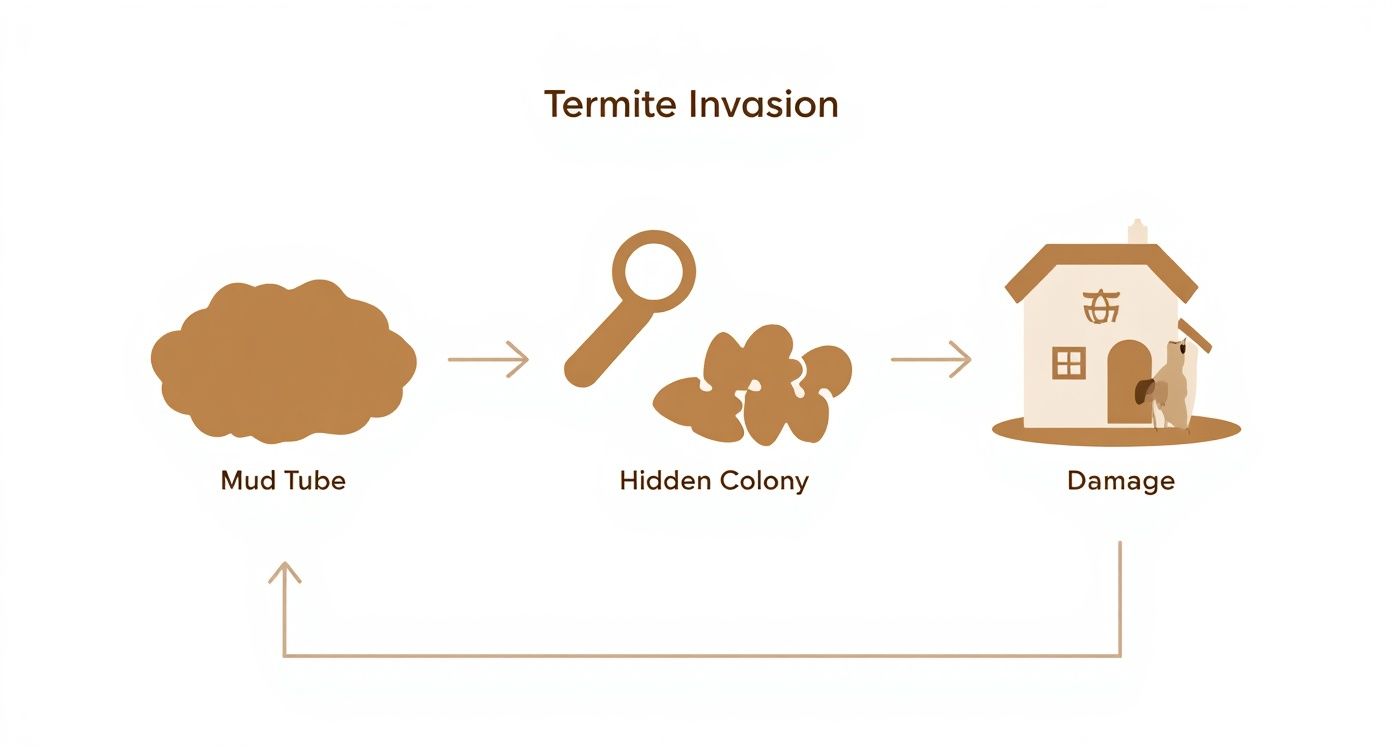
As you can see, the whole disastrous process can start with something as simple as a mud tube, giving a hidden colony a secret highway to start damaging your home's structure.
If your inspection turns up any of these signs, don't wait. The faster you act, the less damage you'll have to deal with later. For more visual examples to help you confirm what you're seeing, check out our guide on how to identify termites. And since a thorough homeowner is a safe homeowner, it's also smart to know how to test for other types of home damage like mold.
If you’ve confirmed you have a termite problem, Call +1 855 224 3071 now for a fast connection to a local expert.
Choosing the Right Termite Treatment in Fayetteville

If you're picturing your house being filled with a chemical fog to kill termites, think again. Modern termite control is much smarter and far more targeted. It's all about creating an invisible barrier they can't cross or, even better, using their own social behavior to wipe out the entire colony.
Once you know you have termites, figuring out the next step can feel overwhelming. Luckily, in Fayetteville, it usually comes down to two highly effective methods. Understanding exactly how each one works is the key to picking the right defense for your home.
Making the wrong call can mean dealing with this all over again in a year or two. A professional can quickly assess your property and lay out the best options. For a clear explanation from an expert in Fayetteville, just Call +1 855 224 3071.
Liquid Soil Treatments: A Protective Barrier
The classic, time-tested method for termite control in Fayetteville, NC, is the liquid soil treatment. The best way to think of it is creating an invisible, protective moat around your home’s foundation.
A trained technician applies a specialized, non-repellent termiticide into the soil. The termites can't see, smell, or taste it, so they crawl right through it on their way into your house. In doing so, they pick up the lethal agent and carry it back to the colony, eventually wiping everyone out.
This is an intensive process. It requires drilling and injecting the termiticide around the entire foundation. A typical application uses about 4 gallons of termiticide for every 10 linear feet, per foot of footer depth. For an average 40 ft x 30 ft house, that can easily mean using 48 gallons of product just for the foundation wall. According to NC State Extension, proper application is everything.
Baiting Systems: A Strategic Approach
The modern alternative to a liquid barrier is a termite baiting system. Instead of a widespread chemical application, this method uses a strategic, targeted attack to eliminate the colony from the inside out.
Professionals place discreet bait stations into the ground at key points around your home. These stations are loaded with a cellulose material that termites find absolutely irresistible.
- Initial Monitoring: At first, the stations just contain a monitoring device. A technician checks them regularly to see if termites have found them.
- Active Baiting: Once termite activity is confirmed, the monitor is swapped out for a slow-acting bait cartridge.
- Colony Elimination: Foraging termites find the bait, eat it, and share it with the rest of the colony—including the queen. This sharing is what leads to the colony’s total collapse.
This method is far less invasive since it doesn't require any drilling into your foundation or concrete slabs. It also doubles as a fantastic long-term monitoring system.
There's no single "best" treatment for everyone. The right choice depends on your home's construction (like a slab foundation vs. a crawl space), the type of soil you have, and how bad the infestation is. An expert can give you the right recommendation.
Comparing Termite Treatment Methods
So, how do you decide between a liquid barrier and a baiting system? This table breaks down the key differences to help Fayetteville homeowners see which option might be a better fit.
| Feature | Liquid Soil Treatment | Baiting System |
|---|---|---|
| Speed | Faster initial results; starts working immediately. | Slower to eliminate the colony; relies on termites finding the bait. |
| Invasiveness | Requires trenching and sometimes drilling into concrete. | Minimal disruption; only small stations are placed in the yard. |
| Process | One-time, intensive application. | Ongoing monitoring and maintenance required. |
| Cost | Initial cost can vary based on the size of the home. Our guide on the cost of termite treatment offers a detailed breakdown. | Often involves an initial setup fee plus an annual monitoring contract. |
Ultimately, walking through these points with a qualified exterminator is the smartest way to get a plan that truly fits your property. For a no-obligation consultation to find the perfect termite control for your Fayetteville, NC home, Call +1 855 224 3071 now.
How to Select a Reputable Exterminator
You might think picking a termite company is all about finding the lowest price. Let me be blunt: that’s often the single most expensive mistake a Fayetteville homeowner can make.
A low-ball offer isn't a good deal; it's a giant red flag. It can signal watered-down chemicals, a rushed job, or an inexperienced tech who misses a critical entry point. When you're dealing with termite control in Fayetteville, NC, getting it done right the first time is everything. Hiring a true professional isn’t an expense—it's an investment in protecting your home's foundation and value.
Your Vetting Checklist
Finding the right company doesn't have to be a shot in the dark. A good exterminator will be transparent and ready to prove their worth. This is your home, so don't be shy about asking the tough questions.
Before you even think about signing a contract, you need clear answers to these critical questions:
- Licensing and Insurance: "Are you licensed for termite work with the North Carolina Department of Agriculture and fully insured?" This is non-negotiable. If they can't produce proof, walk away. It’s your only protection if something goes wrong.
- Treatment Details: "What specific termiticide will you be using, and can you provide me with the safety data sheet?" You have a right to know exactly what’s being applied around your property, especially if you have kids or pets.
- Service Guarantee: "What, exactly, does your guarantee or warranty cover?" Get specific. Does it just cover re-treatment, or does it also cover repairs for any new termite damage that happens after their work? The difference is huge.
Feeling overwhelmed? If you want to connect with a pre-vetted local pro who already checks all these boxes, Call +1 855 224 3071 for immediate help.
Never, ever settle for a single quote. Getting at least three estimates from different Fayetteville-based termite companies is the best way to understand the fair market price and immediately spot a bid that’s suspiciously low or way too high.
Reading Between the Lines of the Contract
The contract is where verbal promises become legally binding. A trustworthy company will give you a detailed document that leaves zero room for confusion. Vague language is a deal-breaker.
Look for a clear diagram of your home that maps out exactly where the treatment will be applied. It should also specifically mark any areas where they found termite activity.
Most importantly, the contract must spell out the terms of the warranty. This includes what could void it, like making home alterations that disturb the chemical barrier they created. A solid warranty should cover re-treatment at no cost if termites come back. The absolute best ones even offer a repair bond, which covers the cost of fixing new termite damage that occurs after their treatment.
Choosing a company based on a strong, clear contract and warranty gives you peace of mind that a cheap, verbal promise simply can't match. For help understanding what to look for in a service agreement, Call +1 855 224 3071.
Long-Term Termite Prevention Strategies
You might think that after a professional treatment, your home has a permanent force field against termites. It's a nice thought, but the reality is, without ongoing vigilance, you're just sending them an invitation to come back.
Effective termite control in Fayetteville, NC, isn't just about wiping out the current colony. It’s about making your property so unappealing that the next wave of termites passes you by. Once the pros have packed up their gear, your work begins. If you need some advice on building a solid prevention plan, you can always Call +1 855 224 3071.
Making Your Home Less Appealing
Termites are simple creatures. They need two things to thrive: wood to eat and moisture to drink. If you take away their food and water, they'll move on. This isn't about massive construction projects; it's about forming simple habits that protect your biggest investment.
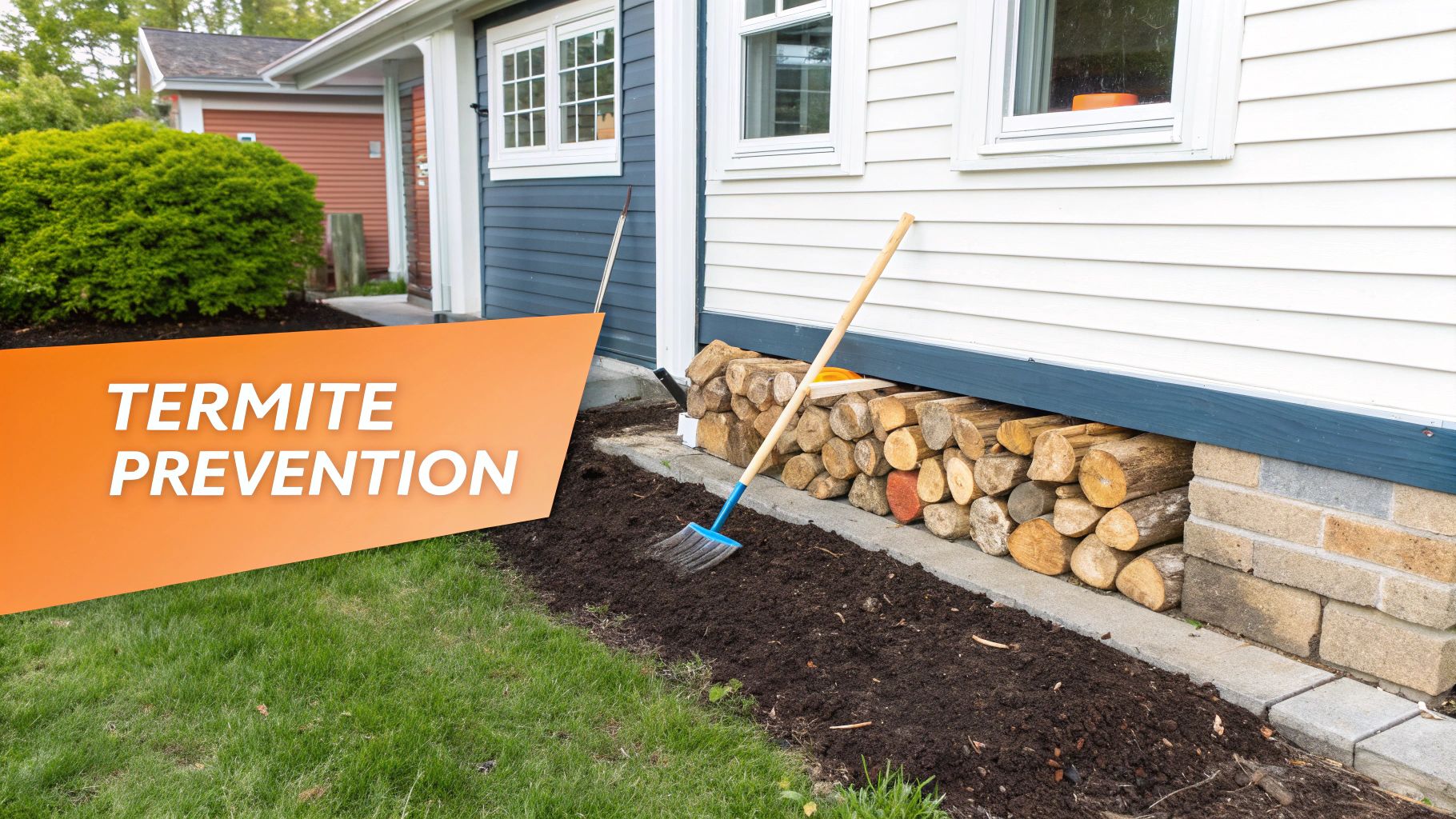
Start by creating a buffer zone around your foundation. This means getting any mulch, firewood, and dense plants away from the side of your house.
- Mulch Management: Pull any wood mulch back at least 6-12 inches from your foundation. That small gap removes a hidden highway for termites to march right from the soil into your home's structure.
- Firewood Storage: Never, ever stack firewood against your house or in your crawl space. Keep it on a raised rack at least 20 feet from your home. This stops termites from nesting in the woodpile and then migrating over to your house for the main course.
- Moisture Control: Fix leaky spigots, add extenders to your downspouts so they drain away from the house, and check that the ground slopes away from your foundation. With Fayetteville's humidity, you have to be proactive about keeping things dry.
These small changes disrupt the exact environment that termites spend their lives searching for.
The Value of Annual Professional Inspections
Even with the best DIY efforts, nothing beats a professional's trained eye. An annual termite inspection is one of the smartest and most cost-effective moves a Fayetteville homeowner can make.
Think of an annual inspection like a yearly check-up for your house. A pro can spot the subtle signs of new termite activity—like a faint mud tube in a hard-to-reach corner of the crawl space—long before it turns into a full-blown crisis.
During an inspection, a technician will meticulously re-check all the high-risk areas termites love, like foundation piers, sill plates, and spots where pipes enter the home. They’ll also verify that your original treatment is still holding strong and look for new vulnerabilities that might have popped up over the year, like a fresh crack in the foundation or a damp spot under a deck.
Catching a problem early means a quick, targeted treatment instead of a massive, expensive repair job down the road. It’s the best way to ensure your initial investment in termite control keeps protecting your home for years to come. To schedule your annual check-up, Call +1 855 224 3071 to connect with a local expert.
Answering Your Top Fayetteville Termite Control Questions
Lots of homeowners picture pest control and imagine crews in hazmat suits spraying harsh chemicals everywhere. That’s an outdated image. Modern termite treatments are incredibly precise and designed to have the smallest possible footprint on your family’s life.
The best termite control in Fayetteville, NC, isn't about blanketing your home in pesticides. It's about creating strategic, invisible barriers or cleverly using the termites' own behavior to wipe out the colony. Let's clear up some common concerns.
If you want answers tailored to your specific situation, just give an expert a quick call at +1 855 224 3071.
Is Termite Treatment Safe for My Family and Pets?
This is always the first question, and it's the right one to ask. The short answer is yes, when done correctly.
Reputable companies only use termiticides approved by the EPA. These products are specifically made for application in the soil outside your home or inside sealed, tamper-resistant bait stations. A licensed professional knows exactly where to apply them—around your foundation and in the ground, where termites live—not in your living room or kitchen.
How Long Does a Termite Treatment Last?
How long you’re protected really depends on the type of treatment you choose.
- Liquid Soil Treatments: Think of this as creating a long-lasting protective bubble around your foundation. A quality liquid treatment can protect a home for 5-10 years, sometimes longer. Factors like Fayetteville’s soil type and our heavy rains can influence that timeline.
- Baiting Systems: This is more of an ongoing defense system. Bait stations are installed around your property to actively monitor for termites and eliminate colonies that pop up. They stay effective as long as you have an annual service contract to maintain them.
No matter which method you go with, a yearly inspection is non-negotiable. It’s the only way to be sure your defense is still holding strong. To talk through which long-term plan makes sense for you, Call +1 855 224 3071.
Why Did I Get Termites if My House Is Brand New?
It’s a frustrating and common myth that termites only go after old, decaying houses. The truth is, new construction sites can be a five-star buffet for them.
Think about it: during construction, wood scraps get buried in the dirt, old tree stumps might not be fully removed, and fresh landscaping needs a lot of water. This creates the perfect combination of food and moisture right next to your brand-new foundation. While pre-construction soil treatments are a great idea, they're often overlooked, leaving a home vulnerable from day one.
The most important thing to remember is this: termites don't care about your home's age, only its accessibility. Any wooden structure in Fayetteville is a target if it isn't protected.
Getting an inspection, even on a one-year-old home, is a smart move. If you're worried about your home's risk level, a professional opinion is just a phone call away. You can connect with a local specialist by dialing +1 855 224 3071.
For fast answers and to get a professional termite inspection scheduled for your Fayetteville home, you need experts you can count on. Pest Control Service Finder links you directly to vetted, local exterminators who are ready to defend your property. You can get a no-obligation quote by visiting https://pestcontrol-service-finder.com.